

This article comprises a segment of the of self-governing and co-design of the Occupied and Reclaimed, Cissie Gool House (CGH) community. It highlights the community garden within the confines of CGH that was designed for the 1000 residents to be able to feed themselves in a post Covid-19 environment and in an economy that is under strain from electricity outages, heavy unemployment, homelessness and crime. The initiative to establish a community food garden that supports communal feeding is starting to blossom with relationships and plans of collective and collaborative action within the Woodstock community. The relationship of Learning in social action – where residents decided on CGH as a place of homecoming, self -learning, collective-care, sufficiency and solidarity permeates all projects – knowledge is shared, it is local, it is rooted deeply within collective social action and solidarity. The article is foregrounded with a short history of the occupation and a narrative that contends for a project to exist within the broader framework of the CGH that contributes to whoever works the land will benefit from its labour, as well as providing opportunities for employment for residents within the informal economy.
Foregrounding the Food Gardens
The occupation and reclaiming of the former Woodstock Hospital in Cape Town in 2017 which stood uninhabited and neglected for more than two decades and repurposing it to what is called Cissie Gool House is a place where community is forged amongst 1000 residents and a place that they call home.
Like any other community trying to forge deep roots, CGH after almost six years of occupation, has not been without the challenges that result from families and individuals who are not a homogenous group, except that they can all identify with being economically and socially marginalised in continuous displacement including the difficulties encountered by thousands of South Africans on a daily basis.
The residents are in constant struggle to make CGH habitable for everyone by organising themselves into disciplinary committees to deal with internal conflict, rule-breaking and gender-based violence. CGH also draws on support from organisations, residents’ association, legal experts, activists, and concerned supporters of the occupation regarding legal information about their rights as tenants and other important issues.
Living the day- to- day in occupation revealed the complexity of CGH’s organisational structures which includes negotiating for refuse collection and water, sanitation and electricity services with city officials; providing food and medical care to elderly, children and destitute occupiers, and sustaining initiatives such as the communal kitchen, and sports and recreational activities for youth in self-governance of this alternative space. Also keeping constant awareness that the solidarity campaign remains alive and supported means constant action plans for protests.
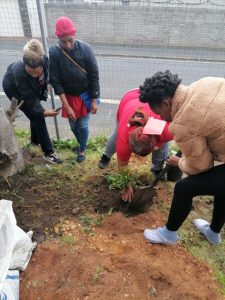
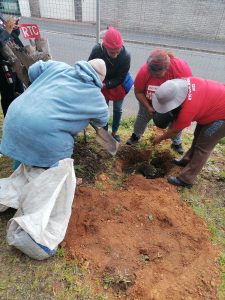
One of the key areas of concern is food security for every resident. To this end the community food garden concept was forged within the existing neglected and overgrown gardens of CGH. A challenging project worth taking on for sustenance and to learn from. Melissa Arendse a monitor of the renamed, Noor Tofie Food Garden, who came to live at CGH in August 2019, gave birth to daughter Cassidy in December 2019 during the Occupation. Melissa recounts that, “when Lockdown for Covid 19 started, I was introduced to working in the garden as part of the feeding scheme in the CGH community. At the time people could earn points for their work that could be translated into a small income. This was initiated by organisations who gave training regarding permaculture. I felt that the garden was my calling not only because I could be kept busy with a toddler at my heels, but also my realisations as an adult learner about the relationship of the earth and society; the relationship between nature and humanity and my role as a steward”.
Germinating the idea of the garden:
The community food garden was started as way to mitigate the impact of Covid-19 in our community in a sense, guerrilla gardening as part of our protest regarding the right of land and ownership and the right to plant on land that has remained inactive for two decades.
It was dependant on the goodwill of individuals swapping seeds and attended workshops at the Oude Molen Eco Village in Pinelands, Cape Town, that focuses on education and empowerment to become self-sustainable and learn about urban farming methods based on permaculture principles. This knowledge was immediately acted upon to assess the viability of the garden environment. Not everyone was prepared to get dirty in the soil to help clear out spaces to allow nature to take its course. But enough residents participated to establish the garden.
Karen narrates that, “I am often reminded of how the garden at CGH started. Boeta Noor (better known by most of us as Oupa) who lived at room 12 on Ground floor in the K-walk section of CGH, was the founder member of the garden back in early 2019. He was my opposite neighbour, my comrade and dearest friend. I live at number 15 Ground floor K-walk section with my son and my elderly father, uncle John. Oupa was a short, elderly, active and very assertive man who was very passionate about the garden. Waking up to start his day at 5am in the garden until midday, and after a few days he cleared up all the high tall weeds and shrubbery. I questioned the oldie about his interest in the garden. At first, he shared with me that the garden had become his place of comfort, of healing and a kind of quiet retreat.
It made him feel like he had a sense of belonging, and a sense of ownership. Not long thereafter, the garden became a safe and comforting space for a few more elderly occupiers, Mamma Rose who lived on Ground floor, Gogo Virginia who lived on first floor as well as Boeta Ebrahim Januarie and Uncle John from ground floor. We renamed the garden Noor Tofie Food Garden after Oupa passed away”.
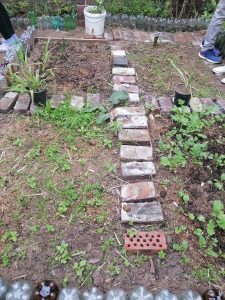

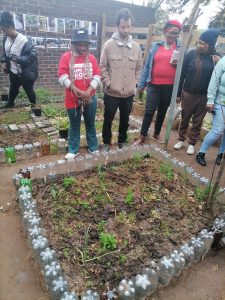

The garden is alive with possibilities and challenges
Karen describes, “Days and weeks passed and after concerns and discussions about the wellness of the elderly and the garden space started taking place weekly. Bernice Roeland, a comrade, supporter and friend of the garden came shared her extensive knowledge, love, skills, and experience with everyone. Within a few days the first compost beds were made.
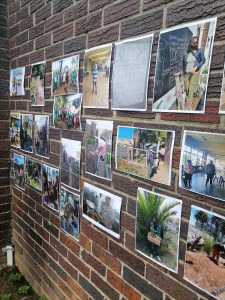
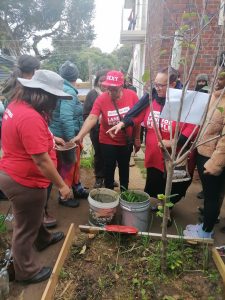
The first official launch of the garden was on Easter Monday in April 2019. What a memorable day it was, which started with storytelling and ended with a working – walking tour of the garden. It was then too that the shared vision of the garden space was birthed. By the November 2019, the first garden fundraiser was formed. The garden team had started with crafting the “Reclaim Your Festive Box” using their skills to produce the contents of the boxes.
The Noor Tofie Food Garden at CGH is a communal space. A space which reminds many of us of our childhood and allows us to connect with neighbouring gardens and other support networks. There remains a sense of continuity, of belonging, of growth, of sharing, of imagining, of community, through story-telling and in action”.
Harvesting what we learnt in the process
In the beginning, we were fortunate enough to be able to draw on the assistance and knowledge from residents like Boeta Noor and Bernice Roeland, who shared their knowledge about medicinal, indigenous herbs and beneficial herbs and plants that would grow well in the clay soil of Mountain Road with its wind, rain and sunny positions.
Key learnings included understanding the principle that everything is connected in a harmonious integration of landscape and people. This included making our own fertilisers by recycling the kitchen waste to make compost; how to address the cats; how to protect the garden from the wind; where were the correct sunny spots to grow our seedlings from scratch and where to plant and so forth.
During the Covid-19 period many residents of CGH were affected. It also created many additional challenges for us which included the communal kitchens, organising and distributing support and pots of food from locals in the community and at the same time adhering to the Lockdown rules and social distancing in our city. Our efforts of self-governing was particularly under constraint at that time.
Therefore, it helped to know that we could drink African Wormwood teas and make Spekboom and garlic chutneys to stay healthy as well as to add to our “Reclaim Your Festive Box” boxes. That in turn could generate a bit of money to buy compost, seedlings and seeds. We relearned that the leaves of the Malva could be crushed and used for earache. We also learned that the indigenous Wild garlic was good for coughs, colds, flu, fevers, tuberculosis, asthma, and as a remedy for intestinal worms. The smell of the bulbs helps keep snakes away. The food garden in a sense allowed us to focus our attention away from sickness and feeling confined within CGH; it created a sense of peacefulness and escape. And as a collective we regained our centre.
Storing seeds for the next season – future plans
The work in the garden started out with small sections that we could plant in, while a huge section is still filled with rubble and was a dumping ground when CGH was uninhabited. We would like the City of Cape Town to assist us with collecting the rubble and we need community volunteers to assist in sorting out the plastic, rotten wood and trash.
We are applying to gain access to the fallow plot of land over the road that gets enough sunlight for planting crops such as green leafy vegetables, salad crops and vegetables.
Our intention is to use the knowledge and skills to harvest enough vegetables for both sharing and selling at a monthly farmers market so that we can buy garden supplies, seedlings.
We need to find a donor who can provide us with water tanks to harvest rain water for our gardens especially over the summer months.
We would also like to continue collaborating with other community gardens where we can all learn and share our experiences.
Above all, we see this garden as a part of the Woodstock landscape which should involve the
Woodstock community, the old age homes, potential garden enthusiasts, volunteers, and schools, to create awareness with the view of a community garden market of locally produced, handmade products for the informal economy that may assist resident artisan, makers and bakers at CGH and within the informal economy.
Conclusions
The CGH community food garden, renamed the Noor Tofie Food Garden, is one of the initiatives in the community of Woodstock, by the community that remains cognisant of the broader campaigns regarding Food Security and Sovereignty. We started this by harnessing the knowledge of planting our own food and medicinal herbs from within our community utilising social action and solidarity. The hope that actively engaging in the actions and activities in the broader landscape of food production to impact on our Ecosystem positively, provide opportunities for adult learners to gain knowledge.
This project in turn is under the auspices of our broader campaign to Reclaim and Repurpose fallow pieces of land in the city that promotes self-governing and co-design concepts.
CGH gives an insight into some of the intangible assets that actually make for dignified housing for poor and working-class people: a common vision, agency, dialogue and consensus building, co-operation, care and decent work. This is a unique opportunity to challenge the exclusion of occupiers from housing solutions and the commodification of land and housing at the neighbourhood level.
The struggle to reclaim CGH has just begun and it may take many years. It may just be the stepping stone we need to inform a systemic model that can bring thousands of poor and working-class people back into the inner city, advance spatial justice and build an inclusive city.
